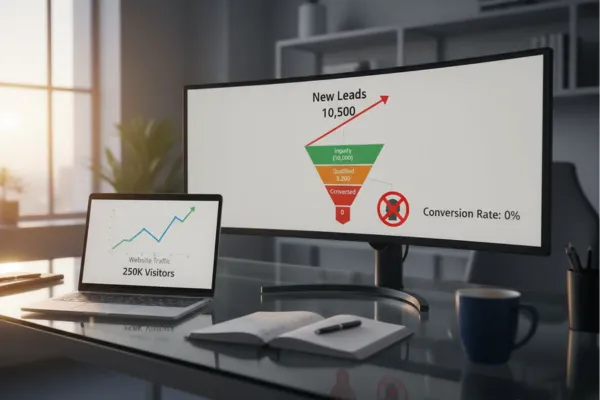
Why Most Leads Never Turn Into Customers (And How to Fix Your Entire Funnel)
“Every unanswered lead isn’t just a missed opportunity — it’s a customer you paid to acquire and then gave away.”

You've invested in marketing. Your website is getting traffic. Leads are coming in. So why isn't revenue growing?
The uncomfortable answer: most businesses don't have a lead problem. They have a conversion problem.
Every day, potential customers find your business, browse your services, and sometimes even reach out — only to disappear without ever becoming paying clients. Not because they weren't interested. Not because your service wasn't good enough. But because something in your process broke down between the moment they showed interest and the moment they needed to make a decision.
That gap — between a lead showing interest and becoming a customer — is where most small businesses silently lose the majority of their revenue. And the worst part? Most business owners have no idea it's happening.
In this guide, we'll break down exactly where leads get lost, why pouring more money into traffic only makes the problem worse, and how to build a conversion system that turns more of your existing leads into paying customers.
Table of Contents
· The Myth: More Leads = More Revenue
· The Real Conversion Funnel (And Why Most Businesses Skip 80% of It)
· The 7 Specific Places Leads Get Lost
· Speed to Lead: The Single Biggest Factor in Conversion
· The Psychology of the Buying Window
· Why More Traffic Amplifies a Broken System
· What a High-Converting Lead System Actually Looks Like
· How to Audit Your Own Funnel in 30 Minutes
· Real-World Example: Doubling Revenue With the Same Lead Volume
· A Practical 90-Day Action Plan
· Frequently Asked Questions
The Myth: More Leads = More Revenue
This belief is one of the most expensive assumptions in small business marketing.
The logic seems sound: if 10 leads produce 2 customers, then 100 leads should produce 20 customers. Double the leads, double the revenue. Simple math — except it ignores the most important variable in the equation: your conversion rate.
Consider two businesses:
• Business A gets 50 leads per month and converts 40% of them → 20 customers
• Business B gets 200 leads per month and converts 8% of them → 16 customers
Business B spends four times as much on lead generation and still ends up with fewer customers. More traffic doesn't fix a broken funnel. It just makes the waste more expensive.
The three levers that drive revenue are:
• Traffic — the number of people who discover your business
• Leads — the number of people who express interest
• Conversion — the number of leads who become paying customers
Most marketing advice focuses almost entirely on the first two. SEO, paid ads, social media, content marketing — these are all traffic and lead generation strategies. They're valuable, but they only work if your conversion process is solid.
The businesses that grow sustainably are the ones that optimize all three — and conversion is almost always where the biggest untapped gains are hiding.
The Real Conversion Funnel (And Why Most Businesses Skip 80% of It)
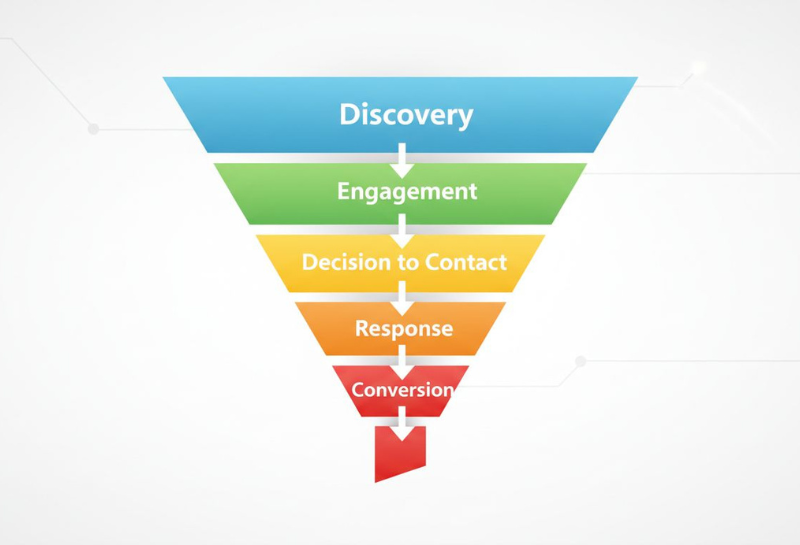
When most small business owners think about their funnel, they think: visitor → customer. But that two-step model skips the most critical stages of the buyer journey.
The real funnel has five distinct stages:
Stage 1: Discovery
A potential customer becomes aware your business exists. This might happen through a Google search, a social media post, a referral, a paid ad, or a local directory listing. This is the stage most marketing spend targets.
Stage 2: Engagement
The prospect visits your website or social profile and evaluates whether you're a credible solution to their problem. They're reading your about page, scanning your service list, looking at reviews, and forming a first impression. Poor UX, confusing navigation, or a lack of trust signals kills conversion here before the lead ever reaches out.
Stage 3: Decision to Contact
The prospect decides they want to learn more or get a quote. This is a high-intent moment — they've moved from passive browsing to active consideration. The barrier here is friction: if your contact form is buried, your phone number is missing, or you only offer one way to reach you, you lose a significant percentage of people at this stage.
Stage 4: Response
Your business receives the inquiry and responds. This is the single most impactful and most neglected stage in the entire funnel. The speed, quality, and consistency of your response here determines whether the lead becomes a customer or disappears to a competitor. We'll go deep on this in the next section.
Stage 5: Conversion
The prospect becomes a paying customer. This is what you're ultimately optimizing for — but it's the natural result of executing every previous stage well.
Most businesses invest heavily in Stage 1 and give almost no systematic attention to Stages 2 through 4. That's the problem. And it's the opportunity.
The 7 Specific Places Leads Get Lost
Leads don't just disappear randomly. They're lost at predictable, fixable points in your process. Here's where the leaks are:
1. Weak or Unclear Calls to Action
Visitors land on your website with intent, but if they don't see a clear, compelling next step, they leave. A weak CTA — or no CTA at all — is one of the most common and most fixable conversion problems.
Instead of generic phrases like "Contact Us" or "Learn More," use specific, action-oriented CTAs: "Get Your Free Quote in 60 Seconds," "Book a Same-Day Consultation," or "See If We Service Your Area." The more specific and low-friction your CTA, the higher your conversion rate at this stage.
2. Too Few Contact Options
Different people prefer different communication channels. Some people want to call. Others prefer texting. Some want to fill out a form. Others want live chat. If you only offer one or two options, you're turning away everyone whose preferred method you haven't provided.
High-converting websites offer multiple contact options — phone, text, contact form, live chat, and sometimes even direct booking — and make all of them easily accessible. Reducing contact friction directly increases lead volume from the same traffic.
3. After-Hours Gaps
A significant portion of consumer research and purchase decisions happen outside of traditional business hours. Evening browsing, late-night searches, weekend comparison shopping — these are real behaviors that generate real leads.
If a prospect reaches out at 9:00 PM on a Friday and doesn't hear back until Monday morning, there's a high probability they've already chosen a competitor. An automated response system that immediately acknowledges the inquiry, sets expectations, and schedules a follow-up call closes this gap without requiring you to be available around the clock.
4. Slow Follow-Up During Business Hours
Slow response isn't just an after-hours problem. Even during normal business hours, a lead that comes in at 2:00 PM and doesn't receive a response until 5:00 PM has likely already moved on. The research on this is clear and consistent: response time is the most powerful predictor of conversion in competitive markets.
👉 Breakdown: The True Cost of Slow Lead Response — [INTERNAL LINK PLACEHOLDER]
5. Disorganized Lead Tracking
When leads come in from multiple sources — website forms, phone calls, emails, Facebook messages, Google Business inquiries — and you have no centralized system to track them, leads inevitably get missed. One channel gets ignored for a few days. An email gets buried. A voicemail goes unreturned.
Without a single source of truth for your lead pipeline, you don't even know what you're losing. You can't improve what you can't measure.
6. Inadequate Follow-Up Sequences
Most leads don't convert on the first contact. Research across industries suggests that the majority of sales require multiple touchpoints — often five or more. But most small businesses follow up once, maybe twice, and then give up.
The leads that don't convert immediately aren't necessarily lost. They may be in a different stage of their decision process, comparison shopping, or waiting for budget approval. A structured follow-up sequence that stays in front of those prospects over days or weeks converts a meaningful percentage of them into customers who would otherwise have been abandoned.
7. No Social Proof or Trust Signals at the Conversion Point
Even a prospect who is ready to buy needs reassurance at the moment they're asked to commit. If your website has no reviews, no testimonials, no case studies, and no trust indicators near your CTAs and contact forms, you're creating unnecessary doubt at the worst possible moment.
Strategic placement of social proof — star ratings near CTAs, specific testimonials on service pages, before-and-after results for service businesses — meaningfully increases conversion rates at this final stage.
Speed to Lead: The Single Biggest Factor in Conversion
👉 Read more: Why Speed to Lead Is the Most Important KPI — [INTERNAL LINK PLACEHOLDER]
If there is one metric that predicts whether a lead becomes a customer more than any other, it's response time.
The relationship between response time and conversion rate is not linear — it's dramatic. Studies across industries have shown that leads contacted within the first five minutes are dramatically more likely to convert than leads contacted even 30 minutes later. And leads that wait hours or days? Most of them are gone.
Here's why the gap is so stark:
Leads Are Actively Searching When They Reach Out
When someone submits a contact form or calls your business, they're not passively browsing anymore. They've moved into active evaluation mode. That means they're likely reaching out to multiple businesses simultaneously — comparing prices, availability, responsiveness, and professionalism. The first business to respond has a significant psychological and practical advantage.
First Response Sets the Relationship
The business that responds first gets to frame the conversation. They establish themselves as attentive, professional, and in demand. By the time the second or third business calls back, the prospect has already formed an impression — and often already made a decision.
Delayed Response Signals Poor Service
From the prospect's perspective, how you respond to inquiries is a preview of how you'll treat them as a customer. A slow response, or no response at all, communicates that your business is disorganized, uninterested, or overwhelmed. Even if none of those things are true, that's the impression it creates.
The 5-Minute Window
The concept of "Speed to Lead" isn't new in sales, but it's dramatically underutilized by small businesses. The target is a first response within five minutes during business hours and an immediate automated acknowledgment outside of business hours. Businesses that consistently hit this benchmark report significantly higher conversion rates on the same lead volume — not because they're better at sales, but because they're simply showing up first and consistently.
👉 See: The 5-Minute Rule for Lead Response — [INTERNAL LINK PLACEHOLDER]
See How Faster Lead Response Works in Practice
If slow response time is costing your business customers, you're not alone — and it's fixable. Automated lead response tools can acknowledge every inquiry instantly, day or night, and keep prospects engaged until your team can follow up.
See how automated lead response systems work with AdStorm AI and how it helps capture, respond, and convert leads automatically: AdStormAI.com
The Psychology of the Buying Window
Understanding why speed matters requires understanding how buying decisions actually work — and it's not the rational, deliberate process most people assume it is.
When a consumer decides they need a service — a plumber, a marketing agency, a cleaning company, a contractor — they enter what behavioral economists call a "buying window." During this window, their intent is high, their attention is focused, and their willingness to make a decision is at its peak.
This window is not permanent. It closes.
As time passes after the initial inquiry without a response, several things happen:
• The prospect's urgency decreases — the problem feels less immediate
• Competing businesses respond and begin to capture their attention
• Doubt creeps in — maybe they should wait, do more research, or reconsider
• Life interrupts — a new priority emerges and your business falls off their radar
This is why a lead that was ready to hire you on Tuesday afternoon may genuinely be unreachable by Thursday morning — not because they found a better option, but because the window closed and they moved on.
The businesses that win are the ones that respond while the window is open. That requires systems, not heroics.
Why More Traffic Amplifies a Broken System
👉 Related: Why More Website Traffic Doesn't Always Mean More Customers — [INTERNAL LINK PLACEHOLDER]
Here's the counterintuitive truth that most marketing agencies won't tell you: if your conversion system is broken, more traffic makes your situation worse, not better.
Consider the math. If your current funnel converts 15% of leads:
• 50 leads → 7-8 customers
• 100 leads → 15 customers
• 200 leads → 30 customers
That looks like growth. But look at what you're throwing away:
• 50 leads → losing 42-43 potential customers
• 100 leads → losing 85 potential customers
• 200 leads → losing 170 potential customers
Every lead you generate but don't convert represents money you spent on advertising, content, or SEO that produced zero return. More traffic doesn't fix this — it increases the cost of the leak.
Now consider the same business after fixing their conversion system and achieving a 35% conversion rate:
• 50 leads → 17-18 customers (vs. 7-8 before)
• 100 leads → 35 customers (vs. 15 before)
• 200 leads → 70 customers (vs. 30 before)
More than double the customers — without spending a single additional dollar on lead generation. That's the compounding power of fixing conversion before scaling traffic.
The most efficient path to revenue growth for most small businesses is: fix the funnel first, then scale traffic. Not the other way around.
What a High-Converting Lead System Actually Looks Like
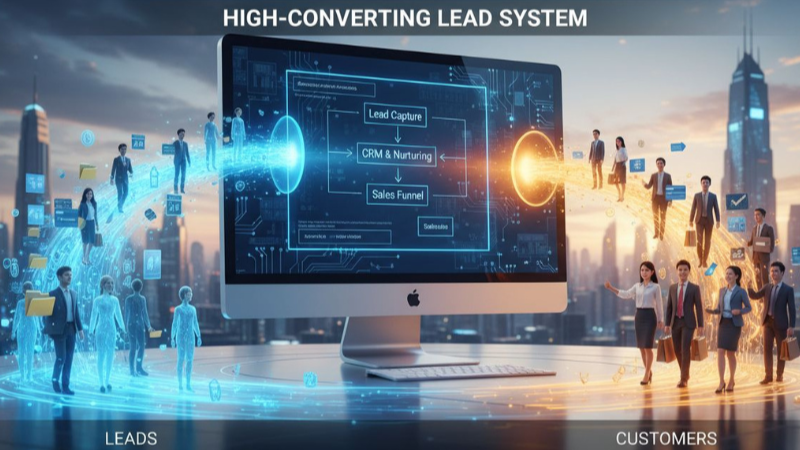
The businesses that consistently convert leads don't just work harder or respond faster by force of will. They build systems that make great response times and thorough follow-up automatic — not dependent on someone remembering to check their phone.
A complete lead conversion system has five components:
1. Immediate Automated Acknowledgment
Every lead — regardless of when it comes in or which channel it comes from — receives an instant acknowledgment. This doesn't need to be a full sales conversation. It needs to confirm that you received their inquiry, set an expectation for when they'll hear from a real person, and keep the conversation alive while you organize a human response.
This single step prevents the most common cause of lead loss: the prospect assuming no one received their inquiry and contacting a competitor instead.
2. Centralized Multi-Channel Lead Capture
Leads come from everywhere: website contact forms, phone calls, text messages, Google Business messages, Facebook inquiries, Instagram DMs, referral emails. Without a centralized system, these inquiries are scattered across multiple platforms and inboxes — and some inevitably fall through the cracks.
A centralized lead management system pulls every inquiry into a single dashboard where it can be tracked, assigned, and followed up on. Nothing gets missed. Nothing falls through the cracks. And you have a complete view of your pipeline at any moment.
3. Structured Human Follow-Up
Automation starts the conversation, but humans close it. After the automated acknowledgment, a real person needs to follow up quickly with a personalized response that moves the conversation forward. This is where your sales process begins — qualifying the lead, understanding their needs, and presenting your solution.
The key is making this step systematic rather than reactive. Defined response time standards, assigned responsibility, and documented follow-up scripts ensure that every lead gets the same quality of attention, regardless of who's handling it.
4. Multi-Touch Follow-Up Sequences
Not every lead converts on the first contact, and that's normal. A structured follow-up sequence — a series of calls, texts, or emails spaced over several days or weeks — ensures that leads who aren't ready to convert immediately are still being nurtured toward a decision.
The sequence should feel helpful, not pushy. Check in with value: answer a common question, share a relevant case study, offer to answer any concerns. Most businesses abandon leads after one or two contacts. A follow-up sequence that continues for 14 to 30 days will convert a meaningful percentage of leads that would otherwise be considered "lost."
5. Conversion Tracking and Optimization
You can't improve what you don't measure. A complete conversion system includes tracking of key metrics: lead volume by source, response time, contact rate, conversion rate, and revenue per lead. Reviewing these metrics regularly allows you to identify where leads are dropping off and make targeted improvements.
Even small improvements — reducing average response time by 30 minutes, improving a single CTA, adding a follow-up touchpoint — compound over time into significant revenue gains.
For a step-by-step breakdown of how to shorten response times across every channel, see How to Reduce Lead Response Time
How to Audit Your Own Funnel in 30 Minutes

Before you can fix your conversion system, you need to understand where it's currently breaking down. Here's a quick audit you can do right now:
Test your own contact experience. Go to your website as if you were a new customer. How easy is it to find your contact information? How many ways can someone reach you? Submit a test inquiry and note what happens next.
Measure your actual response time. Look back at your last 10-20 leads. How long did it actually take to respond to each one? Not how long you think it took — check the timestamps.
Count your follow-up touches. For leads that didn't convert, how many times did you follow up? Was it once? Twice? Was there any system, or was it ad hoc?
Identify your lead sources. Are you receiving leads from multiple channels? Do you have visibility into all of them, or are some channels not being monitored consistently?
Check your after-hours process. What happens when a lead comes in at 8:00 PM? Does anything happen automatically, or does that lead sit until the next business day?
The answers to these five questions will tell you exactly where your funnel is leaking. For most businesses, the audit reveals that response time and follow-up consistency are the primary problems — and both are solvable with the right systems.
Real-World Example: Doubling Revenue With the Same Lead Volume
To make this concrete, here's a realistic example of how a service business transforms their results by fixing their conversion system rather than increasing their lead volume.
The Situation
A home services business is generating 100 leads per month through a combination of Google Ads and organic search. Their average job value is $500. They have a part-time admin who handles inquiries between other responsibilities.
Before: The Broken Funnel
• Average response time: 2-4 hours
• Contact rate (leads that actually spoke with someone): 55%
• Conversion rate (leads that became customers): 18%
• Customers per month: 18
• Monthly revenue: $9,000
The Problems Identified
• No after-hours auto-response — leads coming in evenings and weekends heard nothing until the next business day
• No centralized lead tracking — inquiries from the website form, Google Business, and Facebook were all going to different places
• No structured follow-up — leads that didn't respond to the first call were rarely contacted again
After: The Fixed Funnel
• Immediate automated acknowledgment for all leads, 24/7
• Centralized dashboard pulling inquiries from all channels
• Defined standard: human follow-up within 20 minutes during business hours
• 5-touch follow-up sequence over 14 days for non-converting leads
The Results
• Average response time: under 5 minutes (automated) + 20 minutes (human)
• Contact rate: 82%
• Conversion rate: 36%
• Customers per month: 36
• Monthly revenue: $18,000
Same 100 leads. Same ad spend. Same website. Double the revenue — produced entirely by fixing the process between lead and customer.
A Practical 90-Day Action Plan
Here's how to systematically improve your lead conversion over the next three months:
Week 1-2: Quick Wins
• Audit your current response time and set a target (aim for under 30 minutes to start)
• Add your phone number and a clear CTA above the fold on every key page
• Set up an automated email or text acknowledgment for website form submissions
• Add at least one additional contact method (text, chat, or direct booking)
Month 1: Build the Foundation
• Choose and implement a CRM or lead management system
• Connect all lead sources to a single dashboard
• Define response time standards and assign responsibility
• Write and implement a 3-5 touch follow-up sequence
• Add social proof (reviews, testimonials) near your primary CTAs
Month 2-3: Optimize and Scale
• Review conversion metrics weekly and identify the biggest remaining leak
• A/B test your primary CTA copy
• Implement after-hours automated response with a scheduled callback
• Extend your follow-up sequence to 14-30 days
• Begin tracking revenue per lead by source to optimize ad spend allocation
Even completing the first two weeks of this plan will produce a measurable improvement in conversion rates for most businesses. Each subsequent phase compounds those gains.
Fix Your Lead Response Before Scaling Your Traffic

If your business is generating leads that aren't converting consistently, the problem almost certainly isn't your traffic strategy, your pricing, or the quality of your service. It's the gap between when a lead reaches out and when your business responds — and what happens in the days that follow.
Modern lead response systems can automate the initial acknowledgment, centralize all your channels, and ensure that no inquiry goes unaddressed — while your team handles the human side of closing the sale.
Learn how AdStorm AI helps businesses improve lead response, capture every inquiry, and convert more customers automatically: AdStormAI.com
Conclusion
The businesses that grow most efficiently aren't always the ones with the most leads or the highest ad budgets. They're the ones that have built systems to convert the leads they already have.
Most leads are lost not because of poor service or wrong pricing, but because of slow response, scattered processes, and abandoned follow-up. These are process problems, and process problems have process solutions.
Fix the gap between lead and customer, and you'll find that the traffic you're already generating — the leads you're already paying for — will produce dramatically better results. That's where the real leverage is.
Frequently Asked Questions
Why do most leads not turn into customers?
The most common causes are slow response time, unclear next steps on the website, limited contact options, no after-hours coverage, and lack of structured follow-up. Most leads are lost before a real sales conversation ever takes place — not because the prospect wasn't interested, but because the response process broke down.
What is "Speed to Lead" and why does it matter?
Speed to Lead refers to the time between when a prospect reaches out and when your business responds. It's one of the most powerful predictors of conversion in competitive service markets. Leads contacted within minutes convert at dramatically higher rates than those contacted hours later, because the prospect is still actively evaluating options and the buying window is still open.
What is a good lead response time?
During business hours, aim for a human response within 5-15 minutes. Outside of business hours, an immediate automated acknowledgment that sets expectations for a next-day callback is the minimum standard. Any response time over 30 minutes during business hours creates a meaningful risk of losing the lead to a faster competitor.
Does more website traffic improve conversion rates?
Traffic alone doesn't improve conversion rates. If your conversion system is broken, more traffic simply means more wasted leads. Fixing your response time, follow-up process, and lead management system will produce more customers from your existing traffic than any traffic-generation strategy will.
Can automation replace human follow-up in the sales process?
No. Automation is essential for immediate acknowledgment, after-hours coverage, and structured multi-touch follow-up sequences — but human interaction remains critical for qualifying leads, answering specific questions, and closing the sale. The most effective approach uses automation to prevent lead loss and keep prospects engaged, while reserving human attention for the conversations that actually convert.
How many follow-up attempts should I make before giving up on a lead?
Research suggests that most conversions happen between the 3rd and 8th contact attempt, yet most businesses stop after one or two. A structured follow-up sequence of 5-8 touches spread over 14-30 days is a reasonable starting point for most service businesses. Leads that don't respond after a complete sequence can be moved to a low-frequency long-term nurture list rather than being abandoned entirely.
What should I fix first in my conversion funnel?
Start with response time — it has the highest leverage of any single change you can make. Set up an automated acknowledgment for all incoming inquiries, define a human response time standard, and assign clear responsibility for follow-up. Those three changes alone will produce a measurable improvement in conversion rates within weeks.
How do I know if my conversion rate is good?
Conversion rates vary significantly by industry, but as a general benchmark: a lead-to-customer conversion rate below 15% is a strong signal that your funnel needs work. Rates above 30-35% suggest a well-optimized process. The most important benchmark, though, is your own baseline — measure your current rate, implement improvements, and track progress over time.


