
What Happens After a Lead Comes In? (The Missing System Costing You Customers)
“Leads don’t disappear because they weren’t interested. They disappear because no one responded fast enough.”

Most small businesses spend thousands of dollars generating leads — running ads, building websites, investing in SEO — and then drop the ball the moment a lead actually arrives.
Not because they don't care. Because they don't have a system.
This guide breaks down exactly what should happen after a lead comes in, why most businesses fail at this critical stage, and how to build a lead handling process that consistently turns inquiries into paying customers.
Table of Contents
The First 5 Minutes Matter More Than You Think
What an Effective Lead Response Process Looks Like
What Actually Happens in Most Small Businesses
Understanding the "Lead Black Hole" Problem
The True Cost of Missed Leads (In Real Numbers)
The 5-Part Lead Handling System
Where Businesses Break Down (And Why)
The Psychology Behind Why Speed Wins
How Lead Automation Fills the Gaps
How to Audit Your Current Lead Handling Process
What Changes When You Fix Your Lead Response Process
Frequently Asked Questions
The First 5 Minutes Matter More Than You Think
When a potential customer fills out a form, sends a message, or calls your business, something important is happening in that exact moment:
They're actively searching for a solution
Their intent is at its highest point
They're ready to have a conversation
And in most cases — they've contacted more than one business
Here's what most business owners don't realize: you are rarely the only option being considered.
Customers in buying mode don't wait. They reach out to several businesses and go with whoever responds first, communicates clearly, and makes them feel confident.
Research consistently shows that the odds of qualifying a lead drop dramatically within the first hour — and plummet further with every passing hour after that. The businesses that respond within the first five minutes are far more likely to win the sale than those that respond the same day.
This is why response time is one of the most critical performance metrics in modern marketing.
And when businesses fail to act quickly, the impact isn't small — it's expensive. 👉 The True Cost of Slow Lead Response for Small Businesses
That five-minute window isn't just important. In many industries, it's the entire game.
What an Effective Lead Response Process Looks Like
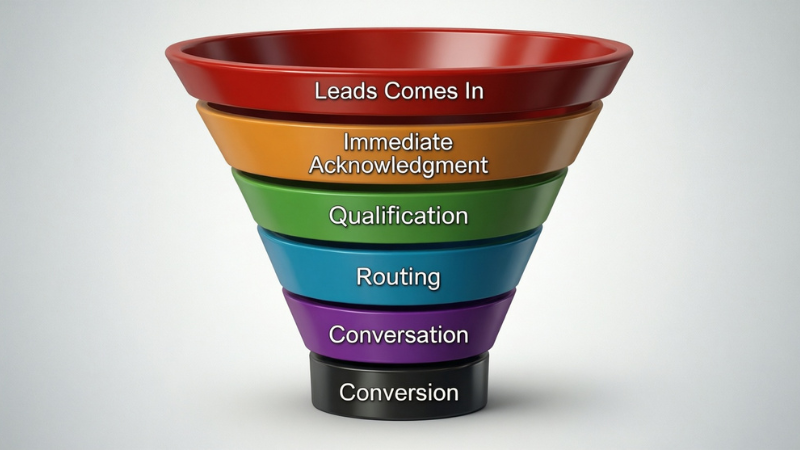
In an ideal world, every lead moves through a structured sequence the moment they reach out. Here's what that process should look like:
Lead comes in — through a form, phone call, SMS, chat, or social media message
Immediate acknowledgment — an automated or near-instant response confirms receipt within seconds
Qualification — key details are gathered before a human conversation begins
Routing — the lead is directed to the right person, team, or next step
Conversation — a real dialogue starts with context already in place
Conversion — an appointment is booked, a quote is sent, or a sale is made
This isn't complicated in concept. But it's surprisingly rare in practice — because most businesses rely on reaction instead of process.
What Actually Happens in Most Small Businesses
Here's the honest picture of how leads are handled in most small and medium-sized businesses:
A lead comes in
It sits in an inbox, voicemail, or form submission folder
Someone notices it when they get a moment
They respond when they can — often hours later
The customer has already moved on
In many cases, the lead never gets followed up with at all. The message gets buried. The voicemail gets forgotten. The form submission gets lost between systems.
There's no tracking. No accountability. No way to even know how many leads were missed or how long response times actually took.
This isn't a lead generation problem. It's a lead handling problem — and it's one of the most common and costly issues in small business marketing.
Many businesses misdiagnose this entirely, assuming the solution is more traffic. 👉 Why More Website Traffic Doesn't Always Mean More Customers
Understanding the "Lead Black Hole" Problem
There's a pattern that quietly costs businesses enormous amounts of revenue every year. Leads come in — but they never come out as customers.
They disappear.
And because there's no tracking system in place, most business owners have no idea how widespread the problem is. They can't see:
How many inquiries were never responded to
How long average response times actually are
Which leads were followed up with and which weren't
How much revenue those missed leads represent
The instinct is to assume the business needs more leads. More ad spend. More traffic. More visibility.
But the real issue — in most cases — is that the business is already losing the leads it's generating.
More leads fed into a broken process don't produce more customers. They just produce more waste.
The True Cost of Missed Leads (In Real Numbers)

It's easy to think of a missed lead as a single lost opportunity. But when you zoom out, the financial picture becomes a lot more serious.
Let's say your business generates 100 leads per month. If your current system only converts 10% of them into customers, you're closing 10 deals. But what if a better lead handling process bumped that conversion rate to 20%? That's 20 customers from the exact same number of leads — double the revenue without spending an additional dollar on marketing.
Now consider what those missed leads are actually worth. If your average customer value is $1,000, and you're losing 10 additional conversions per month due to slow response times and poor follow-up, that's $10,000 in monthly revenue quietly leaking out of your business. Over a year, that's $120,000 lost — not because your marketing failed, but because your process did.
👉 See a full breakdown of what slow lead response is actually costing your business
This is why lead handling isn't just an operational issue. It's a revenue issue. And it deserves the same attention and investment as any other part of your business.
Beyond the immediate sale, there's also the lifetime value of a customer to consider. A single converted lead doesn't just represent one transaction — it represents repeat business, referrals, and long-term loyalty. When you lose a lead to a competitor because you were slow to respond, you're not just losing one sale. You're potentially losing years of future revenue.
The 5-Part Lead Handling System
Fixing this problem doesn't require more effort from your team. It requires a system. Here are the five core components every small business needs to handle leads effectively.
1. Centralized Lead Capture
Leads come in through multiple channels: phone calls, website forms, SMS, social media messages, Google Business Profile messages, and more.
If these channels aren't feeding into a single, centralized system, leads will fall through the cracks — guaranteed. The first step is making sure every inquiry is visible in one place, regardless of where it originated.
2. Instant Acknowledgment
Speed is your single greatest competitive advantage at the top of the sales process.
Even a simple automated message — "Thanks for reaching out. We've received your inquiry and will be in touch shortly." — keeps a lead engaged and signals that your business is responsive and professional.
Silence, on the other hand, loses leads. Customers who don't hear back quickly assume you're slow, unorganized, or not interested — and they move on.
3. Lead Qualification Before the Conversation
Before a member of your team spends time on a call or meeting, the lead should already have answered some basic questions:
What service or product are they looking for?
What's their timeline?
Where are they located?
What's their budget, if relevant?
Gathering this information upfront makes every subsequent conversation faster, more focused, and far more likely to convert.
4. Smart Lead Routing
Not every lead should go to the same person or team. A sales inquiry is different from a support request. A new customer is different from an existing one. An appointment booking is different from a general question.
Without a routing process, leads get delayed, mishandled, or lost between team members. Routing ensures the right lead gets to the right person at the right time.
5. Consistent, Structured Follow-Up
The majority of leads don't convert on first contact. They need multiple touchpoints before they're ready to commit.
Most businesses follow up once — maybe twice — and then give up. But studies show that persistence pays: a significant portion of sales happen after the fourth, fifth, or sixth follow-up.
A structured follow-up sequence, built into your system, ensures no lead is forgotten and every opportunity gets a real chance to convert.
Where Businesses Break Down (And Why)

Even businesses that understand the importance of lead handling tend to fail in predictable places:
No after-hours coverage. Leads that come in evenings and weekends go unanswered until the next business day — often too late.
No centralized system. Leads come from multiple channels and live in different inboxes, apps, and voicemail boxes with no unified view.
Slow response times. Even well-intentioned businesses average hours — not minutes — when responding to new inquiries.
No follow-up process. After the first message or call, there's no structured sequence to re-engage leads who didn't immediately convert.
No visibility or accountability. Without reporting or tracking, no one knows what's working, what's failing, or how many leads are being lost.
Each of these gaps seems small in isolation. But together, they create a system that leaks revenue at every stage.
The Psychology Behind Why Speed Wins
Understanding why fast response times convert better isn't just interesting — it helps you make a stronger case internally for investing in your lead handling process.
When a customer reaches out to your business, they're in a specific emotional and mental state. Their problem is top of mind. Their motivation to solve it is high. They've taken an action — filled out a form, made a call, sent a message — which means they've already moved past passive interest into active intent.
That state doesn't last forever.
Within minutes, distractions set in. They get pulled back into their day. The urgency fades slightly. And if a competitor has already responded by the time they check back, their attention — and their trust — begins to shift.
There's also a first-mover advantage that goes beyond timing. The business that responds first gets to shape the customer's expectations, frame the conversation, and establish rapport before anyone else has the chance. That early relationship creates a natural advantage that's very difficult for competitors to overcome, even if they follow up aggressively afterward.
Fast response also signals something important about your business: that you're organized, attentive, and take customer communication seriously. In industries where trust is a major purchase factor — home services, healthcare, legal, financial services — that signal carries real weight. Customers aren't just evaluating your service. They're evaluating whether you're the kind of business that will show up and follow through.
Speed, in other words, isn't just a tactical advantage. It's a trust signal. 👉 Learn more about why speed to lead is the most important KPI for your business
How Lead Automation Fills the Gaps

You can't personally monitor every channel around the clock. Neither can your team. But your customers don't pause their buying decisions for business hours.
This is where automation becomes a genuine competitive advantage — not to replace human connection, but to make sure no opportunity is missed while your team is focused elsewhere.
Modern lead response automation can:
Send an instant acknowledgment the moment a lead comes in, at any hour
Capture qualification information before a human is involved
Route leads to the right person automatically
Book appointments directly into your calendar
Trigger follow-up sequences for leads that haven't responded
Consolidate messages from multiple channels into one dashboard
Done correctly, automation handles the speed and consistency problem — and hands off warm, qualified leads to your team when human interaction matters most.
How to Audit Your Current Lead Handling Process
Before you can fix your lead handling system, you need an honest picture of where it currently stands. Here's a simple audit you can run on your own business this week.
Step 1: Map every channel where leads come in. List every place a potential customer can reach you — your website contact form, phone number, Google Business Profile, Facebook, Instagram, email address, SMS line, and any other touchpoints. Most businesses are surprised by how many channels they're actually operating across.
Step 2: Test your own response time. Have a friend or colleague submit an inquiry through each of your channels at different times of day, including evenings and weekends. Time how long it takes to receive a response. Be honest about what you find.
Step 3: Check your follow-up history. Look back at the last 20 or 30 leads that came in. How many received a follow-up after the first contact? How many received more than one? How many were never contacted again after the initial response?
Step 4: Calculate your lead-to-customer conversion rate. Divide the number of customers you acquired last month by the total number of leads that came in. If you don't have this number readily available, that's a sign in itself — you don't have enough visibility into your lead pipeline.
Step 5: Identify your biggest gap. Is it response time? After-hours coverage? Follow-up consistency? Lack of centralization? Most businesses have one or two primary failure points that account for the majority of lost leads. Identify yours and start there.
This audit doesn't need to be complicated. The goal is to replace assumptions with data — and give yourself a clear starting point for improvement.
What Changes When You Fix Your Lead Response Process

The results of implementing a real lead handling system are measurable and significant:
Response times drop from hours to seconds
More leads become conversations because fewer slip through unacknowledged
More conversations become customers because follow-up is consistent
Cost per acquisition goes down because you're converting more of what you already have
Revenue grows without needing to increase your marketing spend
The most important shift is this: you stop treating lead generation as the only lever for growth. Because when your lead handling process works, you're finally capturing the full value of the traffic and inquiries you're already generating.
Frequently Asked Questions
What should happen immediately after a lead comes in? An automated acknowledgment should go out within seconds of the inquiry, followed by a human response as quickly as possible — ideally within 5 to 15 minutes during business hours. After hours, automation should hold the lead engaged until your team is available.
Why do businesses lose leads after they come in? The most common causes are slow response times, missed messages across multiple channels, lack of follow-up, and no centralized system to track and manage inquiries.
How much does response time actually affect conversion rates? Response time is one of the highest-impact variables in the sales process. Businesses that respond within the first five minutes are significantly more likely to qualify and close a lead than those that respond an hour or more later.
What is a lead handling system? A lead handling system is a structured process that captures leads from every channel, acknowledges them instantly, qualifies them with key information, routes them to the right person, and follows up consistently until a decision is made.
Can automation replace human interaction in the sales process? No — and it shouldn't try to. Automation handles speed, consistency, and availability. Human interaction is still essential for building trust, answering complex questions, and closing the sale. The two work best together.
How do I know if my lead handling process is broken? Common signs include not knowing your average response time, having no structured follow-up sequence, receiving leads from multiple unconnected channels, and being unable to report on how many leads converted versus how many were lost.
What's the fastest way to increase conversions without spending more on marketing? Fix your response time and follow-up process. Many businesses can significantly improve their conversion rate simply by acknowledging leads faster and following up more consistently — without generating a single additional inquiry.
The Bottom Line
Most businesses don't have a lead problem. They have a system problem.
Leads are coming in. Customers are raising their hands. But without a clear, structured process for responding, qualifying, routing, and following up, those opportunities quietly disappear — and take revenue with them.
The businesses that grow consistently aren't always the ones with the biggest marketing budgets. They're the ones that know exactly what to do when a lead arrives — and have a system in place to do it every time.
Fix what happens after the lead comes in, and everything else in your sales process starts working better.
👉 AdStorm AI is the 24/7 AI lead response system built for local businesses — answering every inquiry instantly, qualifying leads, and booking appointments automatically. See how it works at adstormai.com


