
The Lead Conversion Gap: Why Most Businesses Lose Leads (And How to Finally Fix It)
“The moment a lead reaches out isn’t the end of your marketing—it’s the beginning of your conversion.”
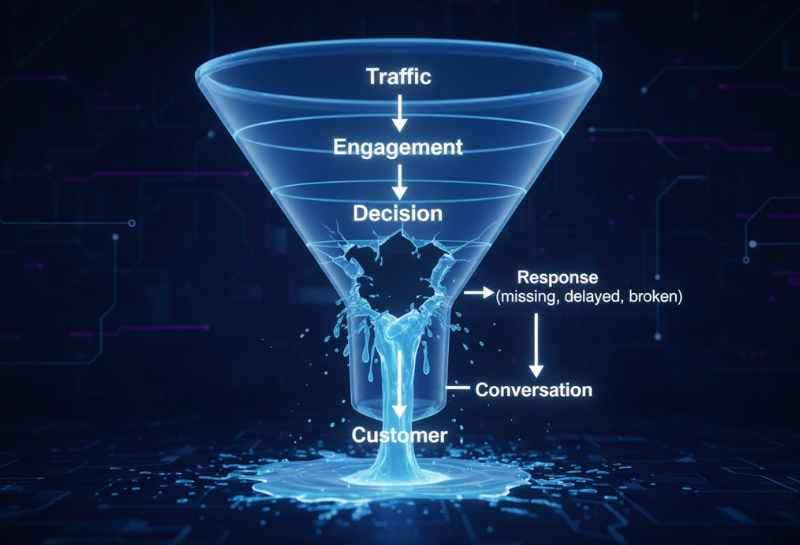
Your business is getting attention. People are visiting your website, clicking your ads, and finding you on Google. Some are even reaching out. So why aren't more of them becoming customers?
The painful truth is that most businesses—even good ones—are quietly leaking revenue every single day. Not because their service isn't great. Not because they aren't getting enough traffic. But because of something that happens in the invisible space between a lead showing interest and that lead actually pulling out their wallet.
That space has a name: the lead conversion gap.
In this guide, you'll learn exactly where leads disappear, why pouring more money into ads often makes the problem worse, and how to build a system that reliably converts more of the leads you're already paying to get. If you run a service business, a local business, or any company that depends on inbound inquiries, this is the most important thing you can read today.
Table of Contents
·What Is the Lead Conversion Gap?
·Why Most Businesses Are Solving the Wrong Problem
·The Real Lead Conversion Funnel (Step-by-Step)
·The 5 Biggest Places Leads Get Lost
·Why Speed to Lead Changes Everything
·The Hidden Cost of Slow Response
·Why More Traffic Makes the Problem Worse
·What Real Businesses Experience When They Fix the Gap
·What a High-Converting Lead System Actually Looks Like
·How to Fix the Lead Conversion Gap in Your Business
·Conclusion: The Gap Is Where Growth Hides
·Frequently Asked Questions
What Is the Lead Conversion Gap?
Most business owners imagine their sales process looks something like this:
Visitor → Customer
Clean. Simple. Linear.
But that's not how it actually works. Between a visitor discovering your business and a customer paying you money, there are several steps—and every single one of them is an opportunity for things to break down.
The real journey looks more like this:
•Discovery — the lead finds your business
•Engagement — they explore what you offer
•Decision to reach out — they decide you might be a fit
•Initial contact — they call, message, or submit a form
•Your response — this is the most critical moment
•Conversation — you build trust and guide them toward a decision
•Conversion — they become a paying customer
The gap happens between steps four and five: the moment of initial contact and your response to it. This is where:
•Leads lose interest and move on
•Competitors step in and win the conversation
•Revenue quietly evaporates
The frustrating part? You'll never see a report that says 'Lost lead due to slow response.' They just disappear. No complaint. No explanation. Just silence.
→ For a deeper breakdown of what happens in this window, see: What Happens After a Lead Comes In
Why Most Businesses Are Solving the Wrong Problem

Here's a scene that plays out constantly in small and mid-size businesses:
Revenue is flat or declining. The owner looks at the numbers and thinks: "We need more traffic." So they hire an SEO agency, run more ads, and start posting on social media every day. Traffic goes up. Leads come in. And revenue... stays the same.
What happened?
The problem was never traffic. The problem was what happened after the traffic arrived.
Think about it this way: if you have a leaky bucket, pouring more water into it doesn't help. It just makes the leak more expensive. The same principle applies here. If your response process is slow, disorganized, or inconsistent, more traffic just means more leads lost to that broken process.
💡 Fixing your conversion system before scaling traffic is one of the highest-ROI moves any business can make.
This isn't a theoretical point. When businesses audit their lead handling, they routinely discover that 30–60% of their inbound leads are never meaningfully followed up with. That's not a traffic problem. That's a system problem.
→ Read more: Website Traffic Doesn't Always Mean More Customers
The Real Lead Conversion Funnel, Step by Step
Let's break down each stage of the real funnel and what businesses typically get right—and wrong—at each step.
Stage 1: Discovery
The lead finds your business through a Google search, an ad, a referral, or social media. Most businesses invest heavily here. They track impressions, clicks, and cost-per-click. This stage is visible and measurable, which is why it gets so much attention.
Stage 2: Engagement
The lead lands on your website or social profile. They start forming an opinion about whether you're credible, affordable, and right for their situation. Good copywriting, social proof, and clear positioning matter a lot here. Again, most businesses at least think about this stage.
Stage 3: Decision to Contact
Something tips the lead from "maybe" to "I'll reach out." This could be a strong offer, a compelling headline, a review that resonated, or simply urgency on their end. The friction of your contact process matters—a complicated form or buried phone number can kill conversions at this stage.
Stage 4: Initial Contact
The lead takes action. They fill out a form, send a message, or pick up the phone. This is the moment of maximum intent. Right now, this person has raised their hand and said "I might want to give you money." They are as warm as they're going to be.
This is also the last stage most businesses actively manage.
Stage 5: Your Response (The Make-or-Break Moment)
Here's where the conversion gap opens up. Most businesses have no real system for what happens next. Leads sit in an email inbox. Voicemails go unchecked. Form submissions get looked at when someone has time. By then, it's often too late.
Studies consistently show that the odds of reaching a lead drop by over 80% if you wait longer than five minutes. And the odds of converting that lead drop even faster. Every minute of delay is a compounding problem.
Stage 6: Conversation
If you do respond in time, the conversation stage is where trust is built and objections are handled. This is where your team's skill matters. But none of that skill gets to show up if you never have the conversation in the first place.
Stage 7: Conversion
The lead becomes a customer. This is the only stage that generates revenue. And it's entirely dependent on every stage before it working correctly.
Most businesses invest heavily in Stages 1–3 and almost nothing in Stages 4–6. That's where the money goes.
The 5 Biggest Places Leads Get Lost
Leads don't disappear randomly. They get lost in the same predictable places, over and over again. Here are the five most common culprits.
1. Missed Calls

Someone picks up the phone to call your business. You're with another customer, in a meeting, or simply not available. It rings out. They hang up.
Here's what most business owners assume happens next: the lead leaves a voicemail, waits patiently, and calls back later if they don't hear from you.
Here's what actually happens: they call the next business on the list.
Consumer behavior research has shown that the majority of callers—especially younger consumers—will not leave a voicemail. They'll simply move on. In a world where every competitor is one Google search away, the bar for patience is incredibly low.
→ Related: Are Missed Calls Costing You Customers?
→ Also: Why Customers Don't Leave Voicemails Anymore
2. Slow Response to Form Submissions and Messages
A lead fills out your contact form at 10:17 AM. You see it at 2:30 PM and respond. By then, there's a good chance they've already made a decision—and it wasn't in your favor.
This isn't an exaggeration. Research from Harvard Business Review found that businesses responding within an hour of a lead's inquiry were seven times more likely to have a meaningful conversation than those responding even an hour later. The decay curve is steep, and it starts immediately.
The reason is simple: when someone reaches out to you, they're usually reaching out to multiple businesses at once. Whoever responds first gets to set the frame. They get to build rapport first. They get to address concerns first. First-mover advantage is real, and it's significant.
→ See: What Is a Good Lead Response Time?
→ And: Speed to Lead: The #1 KPI Small Businesses Can't Ignore
3. No After-Hours Coverage
When do people research service businesses? Often in the evening, after work. Or on weekends, when they finally have time to deal with the thing they've been putting off. This is when a significant percentage of your leads come in.
And for most businesses, this is when absolutely nothing happens.
The lead fills out a form at 8:45 PM on a Friday. You see it Monday morning at 9:00 AM. By then, 60+ hours have passed. If your competitor responded automatically within minutes—even just to acknowledge the inquiry and set expectations—they've already started building a relationship while you were off the clock.
After-hours coverage doesn't mean your team works nights and weekends. It means your system does. Automated acknowledgment, instant follow-up sequences, and AI-powered response tools can bridge the gap without burning out your staff.
4. No Structured Follow-Up System
Here's the follow-up pattern at most businesses:
•Respond once
•Wait a few days
•Maybe send one more message
•Give up and move on
Meanwhile, research consistently shows that most sales require multiple touchpoints before a decision is made. The businesses that follow up systematically—with relevance and persistence but without being annoying—win a disproportionate share of conversions.
The problem isn't a lack of effort. It's a lack of structure. Without a defined follow-up system, individual team members make judgment calls about when to follow up and when to stop. Those calls are usually wrong, because they're based on gut feel rather than data.
A proper follow-up sequence takes the guesswork out of the equation. Every lead gets contacted the right number of times, at the right intervals, with the right message.
5. Fragmented and Chaotic Lead Management
In a typical service business without a centralized system, leads come in through:
•Phone calls
•Website contact forms
•Facebook and Instagram messages
•Google Business Profile messages
•Text messages to the owner's personal phone
Each of these channels is managed separately—or not managed at all. Some leads fall through the cracks completely. Others get seen but never properly followed up with. Nobody has a clear picture of how many leads are actually coming in, how many are being contacted, and how many are converting.
This fragmentation is a conversion killer. Centralizing your leads into a single system is one of the highest-leverage changes a business can make.
Why Speed to Lead Changes Everything

If there's one metric that separates businesses with thriving conversion rates from those constantly chasing their tails, it's speed to lead: how fast you respond after a lead reaches out.
The data on this is clear and consistent across industries. Here's what the research shows:
•Leads contacted within five minutes are 21x more likely to convert than leads contacted after 30 minutes
•The probability of reaching a lead drops by 10x in the first hour
•After 24 hours, most leads are effectively lost
Why is the response window so short? Because leads are in a decision-making state when they reach out. They've identified a problem and they're looking for a solution. That window of active engagement doesn't stay open long. Life gets in the way. They get busy. They get distracted. Or—most commonly—a competitor reaches them first and they're no longer looking.
⚡ The businesses that win the most customers aren't always the best at their craft. They're the fastest to respond.
This feels unfair to business owners who take pride in their quality of work. But the reality is that quality doesn't matter if you never get the chance to demonstrate it. Speed gets you in the conversation. Quality keeps you there.
→ Deep dive: Speed to Lead: The #1 KPI Small Businesses Can't Ignore
The Hidden Cost of Slow Response
Most businesses don't feel the pain of slow response directly. There's no invoice that says "Missed opportunity: $2,400." The losses are invisible because the leads simply disappear. You never see what you were missing.
But consider the math:
•Say your business generates 100 leads per month from advertising and organic traffic
•Your average job or contract is worth $1,500
•Your team reaches 60% of those leads in a reasonable timeframe
•Of those, 30% convert—meaning you close 18 customers per month
Now imagine you could improve your speed to lead and follow-up system enough to reach 80% of those leads instead of 60%. At the same 30% conversion rate, you're now closing 24 customers per month. That's 6 extra customers. At $1,500 each, that's $9,000 in additional monthly revenue—from the same ad spend, the same traffic, the same team.
Over a year, that's $108,000 that was already there. You just weren't capturing it.
This is why fixing your lead conversion system often delivers a higher ROI than any marketing investment. You're not adding new costs. You're recovering existing revenue.
→ See the full breakdown: The True Cost of Slow Lead Response
🔥 If your business is generating leads but struggling to convert them consistently, the problem usually isn't your marketing—it's your response system. See how a complete lead response system works → AdStorm AI
Why More Traffic Makes the Problem Worse
Here's something most marketing agencies will never tell you, because it's bad for their business:
If your lead conversion system is broken, more traffic makes things worse—not better.
Here's why. Suppose your system currently handles 50 leads per month, and because of a broken response process, you're only converting 20% of them. You're closing 10 customers. You feel like you need more leads, so you double your ad spend and now you're getting 100 leads per month.
But the system is still broken. You're still converting 20%. Now you're closing 20 customers—but you're also missing 80 leads per month instead of 40. You've doubled your budget and doubled your losses.
More traffic amplifies whatever your current system does. If your system is strong, more traffic means more revenue. If your system is weak, more traffic means more waste. The fix has to come first.
There's also a qualitative cost here. When leads come in faster than a team can handle them, response quality drops. Rushed follow-ups, forgotten callbacks, and frazzled staff interactions don't just lose individual customers—they damage your reputation.
→ Read more: Why Most Leads Never Turn Into Customers
What Real Businesses Experience When They Fix the Gap
It's one thing to look at statistics. It's another to understand what this looks like in practice. Here are three scenarios that represent what commonly happens when businesses close their lead conversion gap.
The HVAC Company That Stopped Losing Weekend Leads
A residential HVAC company was spending aggressively on Google ads and getting strong traffic. But revenue wasn't matching expectations. When they audited their lead flow, they discovered that a large portion of their form submissions were coming in Friday evenings through Sunday—and not being responded to until Monday morning.
By implementing automated acknowledgment messages and a structured Monday morning follow-up sequence, they dramatically improved their conversion rate on weekend leads without adding any staff or changing their marketing spend. The leads were already there. The system just wasn't capturing them.
The Law Firm That Discovered Its Phone System Was Broken
A personal injury law firm was frustrated by slow growth despite strong SEO rankings. An audit revealed that a significant number of calls were being missed during peak hours—between 11 AM and 2 PM—when staff were at lunch or on other calls. Missed callers were not leaving voicemails.
Adding a simple overflow answering solution and an automatic missed-call text response—acknowledging the missed call and inviting the caller to schedule a time—recovered a meaningful percentage of those lost leads. Small operational fix, significant revenue impact.
The Contractor Who Stopped Chasing Leads Manually
A general contractor was following up on leads manually, which meant follow-up quality depended entirely on how busy the week was. During slow periods, leads got excellent follow-up. During busy periods, leads were forgotten entirely.
Implementing an automated follow-up sequence—initial response, check-in at 24 hours, follow-up at day three, final touch at day seven—standardized the process regardless of how busy the team was. Conversion rates improved not because more leads came in, but because fewer leads fell through the cracks.
What a High-Converting Lead System Actually Looks Like

Businesses that consistently convert a high percentage of their leads don't rely on individual heroics or perfect timing. They rely on systems. Here's what those systems include.
1. Immediate, Automated Acknowledgment
Every single lead gets acknowledged instantly—whether it's 2 PM on a Tuesday or 11 PM on a Sunday. This doesn't have to be a full response. It just has to confirm that you received their inquiry and set an expectation for when they'll hear from a human.
Something as simple as "Thanks for reaching out! We've received your message and someone will contact you within [X] hours" dramatically reduces the rate at which leads move on to competitors. It signals professionalism and reassures them that their inquiry didn't vanish into a void.
2. Centralized Lead Capture
All leads—regardless of channel—flow into one place. One dashboard. One inbox. One view of every lead and where they are in the process.
This sounds basic, but it's genuinely rare. Most businesses manage channels separately, which means leads get missed, duplicated, or followed up with inconsistently. Centralization eliminates that problem.
3. Rapid Human Follow-Up
Automation handles the immediate acknowledgment, but a real human needs to follow up quickly during business hours. The goal is a personal touch within 5–15 minutes of a lead coming in during business hours. This is where the real conversation begins.
→ How to make this achievable: How to Reduce Lead Response Time (Step-by-Step)
4. Lead Qualification Before the Conversation
The best systems gather basic qualifying information before a human gets on the phone or meets in person. This saves time for everyone and allows your team to show up to conversations prepared. Automated intake forms, pre-qualifying chatbots, or smart follow-up questions can handle this efficiently.
5. Smart Lead Routing
In businesses with multiple team members or departments, leads should be routed to the right person automatically. The wrong person getting the lead—or no one knowing who's supposed to handle it—causes delays and confusion that costs conversions.
6. Multi-Touch Follow-Up Sequences
Not every lead converts on first contact. A defined follow-up sequence ensures that leads get the right number of touches, at the right intervals, through the right channels. Email, text, and phone—used appropriately—each have their place.
7. Tracking and Accountability
What gets measured gets managed. The best lead systems track response time, follow-up completion, and conversion rates at each stage. This data makes it possible to identify where leads are being lost and continuously improve.
How to Fix the Lead Conversion Gap in Your Business
You don't need to overhaul everything at once. Here's a practical sequence for closing the gap in a way that's sustainable and prioritized by impact.
Step 1: Audit Your Current Response Time
Before you can fix anything, you need to know how bad things actually are. Spend one week tracking exactly how quickly your team responds to every inbound lead. Include phone calls, form submissions, social messages, and any other channel where leads come in.
Most businesses are genuinely shocked by what they find.
Step 2: Centralize Your Leads
Pick a single CRM or lead management system and route everything through it. This single change eliminates a massive amount of dropped leads and makes follow-up dramatically more consistent.
Step 3: Set a Response Time Standard
Decide what "good" looks like for your business. The industry benchmark is 5–15 minutes during business hours for high-intent leads. Set this as an expectation, not a goal.
Step 4: Add Automated Acknowledgment
Implement automated responses for after-hours and high-volume periods. This doesn't replace human follow-up—it buys time and keeps leads warm until a human can respond.
Step 5: Build a Follow-Up Sequence
Map out a specific sequence for what happens after initial contact. How many times will you follow up? At what intervals? Through which channels? Write this down, build it into your system, and make it automatic.
Step 6: Measure, Review, Improve
Every month, review your lead-to-customer conversion rate. Track where leads are being lost. Test changes. The businesses that continuously improve their conversion systems compound their advantages over time.
Conclusion: The Gap Is Where Growth Hides

Here's the truth that most marketing conversations miss: the biggest growth opportunity in most businesses isn't found in more traffic. It's found in better conversion of the traffic already coming in.
The lead conversion gap is real, it's costly, and it's almost entirely fixable. You don't need more leads. You need better systems to handle the leads you already have.
Fast response. Centralized management. Consistent follow-up. These aren't glamorous. They don't make for exciting marketing case studies. But they are the mechanical difference between businesses that grow and businesses that stagnate while spending the same amount on ads.
Fix the gap, and everything else starts working. Your ad spend gets more efficient. Your team's effort pays off more. Your revenue grows—not because you got lucky, but because you built a system that doesn't let opportunities slip away.
The leads are there. The question is whether you're ready to catch them.
🔥 Already investing in traffic, ads, or SEO—but leads still aren't turning into customers? There's a good chance your system is the problem. See how to capture, respond to, and convert every lead automatically → AdStormAI.com
Frequently Asked Questions
What is the lead conversion gap?
The lead conversion gap is the space between when a lead first reaches out to your business and when they become a paying customer. It's the stage where most businesses lose the majority of their potential revenue—not because of bad marketing, but because of slow or nonexistent response systems.
Why don't leads convert even when they seem interested?
The most common reasons are slow response time, missed calls, no after-hours coverage, inconsistent follow-up, and leads falling through the cracks when they come in through different channels. Each of these is a system problem, not a quality problem.
What is speed to lead and why does it matter?
Speed to lead is how quickly your business responds after a lead reaches out. It matters because leads are in a time-sensitive decision-making window when they inquire. Research shows that leads contacted within five minutes are dramatically more likely to convert than those contacted 30 minutes or more later. The window closes fast.
→ See: Speed to Lead: The #1 KPI Small Businesses Can't Ignore
How fast should I respond to leads?
The industry target is 5–15 minutes during business hours for high-intent inbound leads. For after-hours leads, an automated acknowledgment within minutes—combined with a human follow-up first thing the next business day—is the minimum standard you should aim for.
Can I fix this without hiring more staff?
Yes. Most of the improvement in lead conversion comes from systems, not headcount. Automated acknowledgment, centralized lead management, and structured follow-up sequences can dramatically improve your conversion rate without adding staff. Technology handles the speed and consistency; your existing team handles the relationships.
What should I fix first?
Start with response time. It has the biggest immediate impact on conversion rates. Then move to centralization (so nothing gets missed), then follow-up sequences (so leads that don't convert immediately still get nurtured properly).
Does more traffic help if my conversion system is broken?
No—it makes things worse. More traffic into a broken system means more leads lost, more money wasted, and often more stress on your team. Fix the system first, then scale traffic. That sequencing matters enormously.
→ Read: Why Most Leads Never Turn Into Customers
What tools do I need to fix the lead conversion gap?
At minimum: a CRM or lead management system to centralize your leads, an automated response tool for immediate acknowledgment, and a structured follow-up system. Many all-in-one platforms can handle all of this.
→ See how it all works together: AdStormAI.com


